
KBIS 2026: Driving Global Innovation in Kitchen & Bath

In conversation with Bill Darcy, Global President & Chief Executive Officer, NKBA | KBIS
KBIS (Kitchen & Bath Industry Show) is North America’s largest trade show dedicated entirely to kitchen and bathroom design. Hosted annually by the National Kitchen & Bath Association, the event serves as the global hub for discovering the latest technological innovations, finishing materials, and industry furnishings, and takes place concurrently with Design & Construction Week in Orlando and Las Vegas, alternating between the two cities every other year.
We spoke with Bill Darcy about bathrooms and kitchens industry, technology, architecture, and the future of trade shows.
Discover more on KBIS 2026

The Kitchen & Bath market: key economic drivers post-KBIS 2026
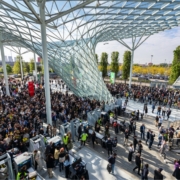
The 2026 edition of KBIS in Orlando was a huge success, attracting 117,000 trade visitors during Design & Construction Week. The report highlights positive prospects for the bathroom and kitchen sector: what are the key economic drivers?
“KBIS 2026 Orlando was a highly successful edition, where new products and, above all, product innovation emerged with great force. Although the U.S. economy has been stagnant for some time, it’s starting to show signs of recovery, and we have reasonable hopes of seeing a recovery begin in the second half of 2026. These hopes stem both from the fact that companies are presenting interesting products and from the fact that the design community remains very active, which creates the perception of a rebound in demand.
These companies wouldn’t be on the market with all these products, and designers wouldn’t be ready to use them, if they didn’t think consumers were ready to invest in bathrooms and kitchens. Of course, the period of economic instability has made American consumers more cautious.”
In light of the results from KBIS 2026, do you think this situation applies to the entire United States, or to some areas more than others?
“Some areas are performing better, others a bit less so, but overall, the market paints a picture of a substantially uniform recovery. It’s true that, although international, KBIS 2026 took place in Orlando, Florida – an area where the market is very strong. Undoubtedly, a vibrant area like this reflects its energy on the trade show and business, but it’s not a local trade show. So if the results are positive, it means that, in general, the U.S. market is recovering. And this is not just positive for the United States; it’s positive for everyone, because the United States is one of the major export markets for many countries. Today, the world is increasingly interconnected, the economy is open, and so are the markets; therefore, if the economy is doing well, it’s good for everyone.”
The evolution of trade shows: how KBIS and NKBA are building a year-round Global Network
The topic of interconnectivity leads directly to another important issue: the role of KBIS and trade shows as networking platforms. Now that trade shows are undergoing significant changes, how do you see the development of KBIS from a trade show into a global platform for designers and manufacturers?
“Trade shows have always been places where people come together. I’ve been working with NKBA for 20 years and have followed the evolution of trade shows over that time. I was already at KBIS when the property crisis hit, and I was there the year of the pandemic, when KBIS didn’t take place. And I can say that even before COVID – though we had no idea what was about to happen – people were already questioning the future of trade shows.
However, after the pandemic lockdowns, people returned to meeting in person, increasingly expressing a desire to connect, to see things up close, and to touch them firsthand. And this applies to food products, bathroom and kitchen technologies, and furnishings alike. For “physical” products – the ones we want to see and touch – the trade show remains the premier venue. And even more so, we want to meet people, exchange impressions, information, and knowledge.
For this reason, KBIS, like many other trade shows, is an ideal platform for meeting people – both those you already know and new acquaintances – seeing all the latest product innovations, and discovering new things.
This positive atmosphere, in a way, influences the economy because it generates an energy that recharges visitors.”
Technology and well-being: the open kitchen revolution and changing social habits
This year, many innovations have been presented, from smart appliances to sustainable materials. From your perspective, what might be the “next big revolution” that will radically change the way we experience the kitchen and bathroom?
“Rather than a major revolution, I would speak of trends that are already emerging but will become increasingly evident: technology and well-being. In the kitchen, for example, there are now appliances that communicate with each other, surfaces that charge electronic devices, and technologies to reduce noise. But I believe the major trend we’re seeing in the United States is the kitchen taking over the entire home: the traditional dining room is disappearing. Even in smaller homes, kitchen sizes have grown considerably. And this likely represents a major shift in social habits as well, because in this way the kitchen expands into the living room, and when entertaining guests – or simply spending time with family – the preparation and consumption of meals become the heart of social and emotional connections.
All these changes in social habits are leading to changes in the way we design home as well. Whereas the kitchen used to be a world unto itself, as the walls separating it from the rest of the house come down, the design of the different rooms becomes much more cohesive: there are no longer separate spaces that simply add up, but a single design that encompasses the entire home. In the long term, all of this is also driving changes in products.”

Beyond Manhattan: NKBA Strategies and Growth Hotspots for International Brands in the U.S.
The NKBA Global Connect program is a vital bridge for international trade. For European and international brands looking to the U.S. market, what is the most important advice you can offer for successfully integrating into the American ecosystem?
“The key starting point is always the relationship between people; building a network of relationships is even more important in the United States than in Europe. There are brands from countries with which there is a “natural,” instinctive affinity, such as Italy, Germany, and Brazil, but it’s still essential to build quality relationships. Then there’s another key factor to take into account: from abroad, we tend to think of the United States as a single country, but the reality is that we should treat as eight different countries.
There are brands that think of opening a showroom in New York as a starting point. But that isn’t necessarily the best choice: why not Austin, Dallas, South Florida, or Rochester, in New York State? They are rarely mentioned, yet they are emerging hotspots in the United States. Salt Lake City, Utah, is booming! It’s a matter of understanding what kind of product one has, where the population in the United States with which one has the greatest affinity is located – a fact that can guarantee the best short-term success in achieving results. And the best destination might just be Salt Lake City, not Manhattan.”
So, is the best approach to exhibit at a trade show?
“I think so, and especially at a trade show that allows to maintain contacts throughout the year. NKBA, for example – the association that organizes KBIS – has 70 local chapters, and members attend events, socialize, and build relationships. No one is saying it’s easy, but I see it as a necessity. The Global Connect program that NKBA offers brands serves precisely these purposes: we provide a list of pre-selected consultants. This is also because, with certain products, there are additional issues to consider: a plumbing product must comply with specific standards and regulations, and we offer consulting on these aspects as well. I call it omnichannel marketing, because it activates multiple channels: participation in trade shows, the local market, and ongoing relationships. But of course, it is always necessary to truly believe in the investment.
Then there are other things to think about, like the shift from exporting to internationalization, which is a whole different deal. Selling is a start, but what comes next? What’s the best way to serve customers? What’s the fastest way to get the product to them? Especially since we’re often talking about really heavy stuff in this industry. Some companies have made the long-term decision to open factories in the United States. Not everyone has to do this; these are choices each company must weigh carefully. In any case, I think it’s clear that the strategy for entering the U.S. market must be long-term and broad-based. And that NKBA and KBIS can provide the necessary support.”

From Orlando to Las Vegas: elevating business, digital content, and immersive hospitality
The debut of the KBIS LIVE Studio highlighted a strong push toward digital content. How important is it for professionals to have a digital platform accessible year-round, one that transcends the physical limitations of the trade show? Does this digital strategy support the association’s members? And in what ways?
“I come from a family where technology has always been a part of our lives; my father worked at Hewlett-Packard, and during my first years of college I studied computer science. I later changed my course of study, but my passion for technology remained, and I use LinkedIn constantly for work. At KBIS, we didn’t have a real channel for digital communication, and I think it’s important to have one; we could significantly increase the number of visitors with more widespread digital communication. For this purpose, we partnered with Homeworthy, the YouTube channel with a massive following for home-related content, and created KBIS Live Studio.
Furthermore, digital communication can greatly help companies connect with their audience year-round, not just during the days of the trade show. Before COVID, there was a sort of fear that digital would replace trade shows; now, we’ve realized that not only is that not the case, but that digital can also be a very useful complement to help designers access information and content without time constraints.”
Next year, KBIS returns to Las Vegas. Every city brings a different energy to the table: what’s already planned to make the next edition even better than the last one?
“KBIS Orlando, despite the 2026 edition going very well, I don’t think it can grow much further, due to many reasons. KBIS Las Vegas, on the other hand, has a great deal of potential yet to be developed. Las Vegas, as a city, is a perfect partner for the trade show. They’ve designed their infrastructure around hospitality and events, and that’s also part of an event’s success. In Las Vegas, they have the most cutting-edge convention space in the world, with excellent hotels, many restaurants, and the Tesla Tunnel. Moreover, in Las Vegas, companies also have a relationship-oriented mindset, and exhibitors are in the right frame of mind to do business even in the evening at a restaurant.
Furthermore, I believe the home industry has much more potential than it currently demonstrates, precisely because it is not about cars or technology. For this reason, I truly believe we will continue to grow, and if we can further improve our hospitality. Providing our guests with an exceptional experience, in addition to selecting the right products, of course, we can become a trade show of great global significance.”
Future Outlook: Why Essential Renovations and Social Trends Keep the Sector Moving Forward
Where is the Kitchen & Bath sector heading?
“I’m optimistic; I already see signs of recovery in the second half of this year. Of course, in times of economic uncertainty like these, people tend to save money and are not really willing to make major investments. But that doesn’t change the fact that in the United States there’s a market of about twenty million homes in need of renovation, particularly in the kitchen and bathroom. It must be considered that there are things that cannot be put off. For example, if the refrigerator breaks down or the bathroom sink breaks, replacement cannot be delayed. And these could be opportunities to undertake slightly more significant renovations.
Then there is an aspect related to trends and social media. The world is constantly flooded with things that seem better than what we already have, and we are influenced by them. We desire them, and even if we know we can’t afford them, we convince ourselves we need them. Combining the need for repairs with the influence of social media and television leads to investments in new home improvements. That’s why I’m confident that as soon as the economy stabilizes a bit, investment will pick up again.”




Leave a Reply
Want to join the discussion?Feel free to contribute!